

“…a legend at the peak of his game.” The man said.
At any point in Chicago, post 1984, a resident hears those words and unquestionably knows who the speaker is referring to: Sir Michael Jordan. I personally accumulated enough MJ posters in my youth to supply the paper on a $300 college textbook. So when I hear such an audacious sentence, my heart starts pumping a bit faster as the mental highlight reel kicks on. However, it was a bit strange hearing those words within the context of this particular conversation. It was in reference not to the iconic basketball star who soared like an eagle and wore suits like a don, but rather a scrawny computer nerd who ate like a squirrel and wore turtle necks like a fifth-grader.
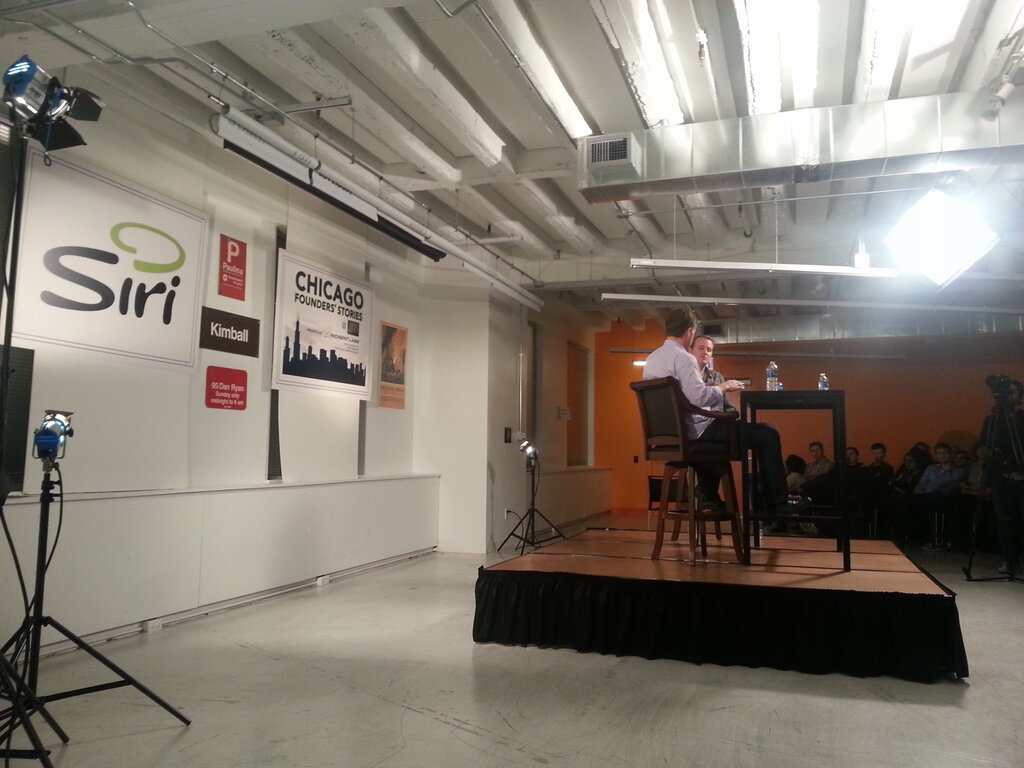
I was sitting inside Chicago’s entrepreneurship hub, 1871, at a “Founders Talks” event. Scores of Chicagoans packed the auditorium to witness a live interview with Dag Kittlaus- founder of the iPhone’s stepdaughter, Siri. At this point in the conversation all two hundred or so attendees’ ears were perked as Dag described being courted by Steve Jobs.
“After about seven miss-swipes on my iPhone I was able to answer the random unknown number, only to hear a soft voice on the other end.” The conversation went as follows:
“Hello”
“Hi, is this Dag?”
“Yes, who’s this?”
“This is Steve Jobs”
“…really?!”
On that note, an alternative excitement spurred through my veins. My mind switched from the MJ highlight reel stored in my memory to the “Steve Jobs by Walter Isaacson” eBook file stored on my iPad (sacred doctrine in digital startup world). If not for Dag’s voice, one could hear a microchip drop on the floor of 1871’s auditorium.
Dag went on to tell of the ensuing one-on-one fireside talks with “Steve” that would lead to Siri’s acquisition by Apple.
“…every entrepreneur ultimately wants to see their baby become huge, and the opportunity to work directly with the most influential man in the history of computers was kind of irresistible.” He said.
Working amongst the world’s most elite innovators wasn’t exactly new to Dag & team. They built Siri while acting as an “entrepreneur in residence” at the Stanford Research Institute. Not bad for a kid who started off selling t-shirts at Taste of Chicago before attending Indiana University.
Among his many insights, Dag gave in depth predictions for why the self-driving car could be a greater revenue pull for Google than search, and how medical data-storing microchip implants will save millions of lives. As Chicagoans, he also made us giddy by declaring it unnecessary to be able to code in order to make it as an entrepreneur (although it certainly doesn’t hurt). He even mentioned that research initiatives at UofI could provide a resource on par with the Stanford Research Institute -an imperative asset for Chicago to truly compete with Silicon Valley.
These weren’t phantasmic ramblings either, it was all immediately realistic. We weren’t kids sitting in basketball camp being told by a 7 foot phenom that if we dreamed hard enough, we too could play professional ball. We were budding entrepreneurs of all ages, realizing that if you scheme carefully, and throw in enough hustle, the resources are now in place to execute on a startup. To me this was just another modern-Chicago day at 1871, but Dag reminisced on a few years ago.
“In Chicago, it used to be cool to say something like ‘I’m the VP at Allstate.’”
I’m not quite old enough to remember when it was cool to be the VP at Allstate, but his message was clear. There’s a rapidly evolving cultural shift occurring in Chi Town. Sure, we’re not quite at the Silicon-level where every schmuck grabbing a cup of coffee is simultaneously inking a venture deal, but we’re moving along.
For example: within two minutes of walking into this event, I see a guy who I know, he tells the girl he’s talking to that I have a cool idea, and next thing I know I’m holding a business card which reads “Goldman Sachs”. The entrepreneurial bug is spreading like wild fire through Chicago, and even the “big dogs” are catching it.
BuiltInChicago.org, recently released a few exciting statistics: in 2012, Chicago-based startups raised $391 million in venture capital, took part in 26 acquisitions, made $698 million in exits, and enjoyed one IPO (Acquity Group). Oh, and at least 50 of those participating venture capital firms came from out of state to dump their cash on the Chicago ‘trep scene. 1871 alone houses over 220 of those startups –including Packback, which I helped co-found to save students money with digital textbooks.
After the event, I had a chance to catch up with 1871’s head honcho, Kevin Willer, who originally earned his stripes by building the Midwest presence of a little company called Google.
With Jordan fresh on the mind, we touched a bit on hoops and a side-gig I work with the Chicago Bulls.
Kevin, all too familiar with Chicago youth’s hoop dreams, described a typical scene he would encounter at Google. They used to bring inner-city kids in to the office for various learning events. Without doubt, Kevin would have this sort of conversation:
“What do you want to be when you grow up?” Kevin asks.
“A basketball player!!” A youngster inevitably shouts.
“You do know that even Lebron James is worth only a small fraction of Larry and Sergey right?”
“Uhh?”
“Be an entrepreneur!”
But this of course didn’t resonate, and how could it? There was no structure for it in Chicago. When the 99.999% of kids who didn’t make it to pro sports had their dreams compressed into a working world that considered the VP of Allstate to epitomize “cool”, where did the entrepreneurs fit? Mostly, they didn’t, so they’d ship out to California with the other corporate rejects.
But with the changing culture comes an equally evolving maturation of “cool”. More and more of those hyper-competitive kids, who find their sports dreams deflated, are realizing there’s a pretty sweet adrenaline-pumping alternative path in the wild world of entrepreneurism –and it accepts all shapes and sizes.
Hearing a statement such as:
“…the automatic car is the next big thing. It generates 1.3 million data points on ten 360 degree rotations per second and may be the answer to our $260 billion annual costs associated with traffic accidents.”
…is suddenly more exciting than:
“Joe Schmo is the next big thing. He averaged 21 points as a freshman and may be the answer to the Bulls’ two-guard dilemma.”
Driving innovation is a necessary elation. Chicago is answering the call.
Now don’t get me wrong, the six championship banners hanging from the Madhouse rafters have by no means been forgotten. And while Steve Jobs is likely deserving of his industry’s highest possible praise: “The Michael Jordan of… computers”, it’s unlikely we’ll be referring to Derrick Rose as the “Zuckerburg of hoops” anytime soon. Even Dag’s brain-children have their flaws. To truly test her knowledge, I asked: “Siri my dear, who is the best basketball player ever?” To my disgust, she replied, “It’s hard to say Mike, I’m not sure who the best player is”. Perhaps 1871 will give birth to technology’s truly “next big thing”: a common sense algorithm.